A charming and unique ground-cover rose
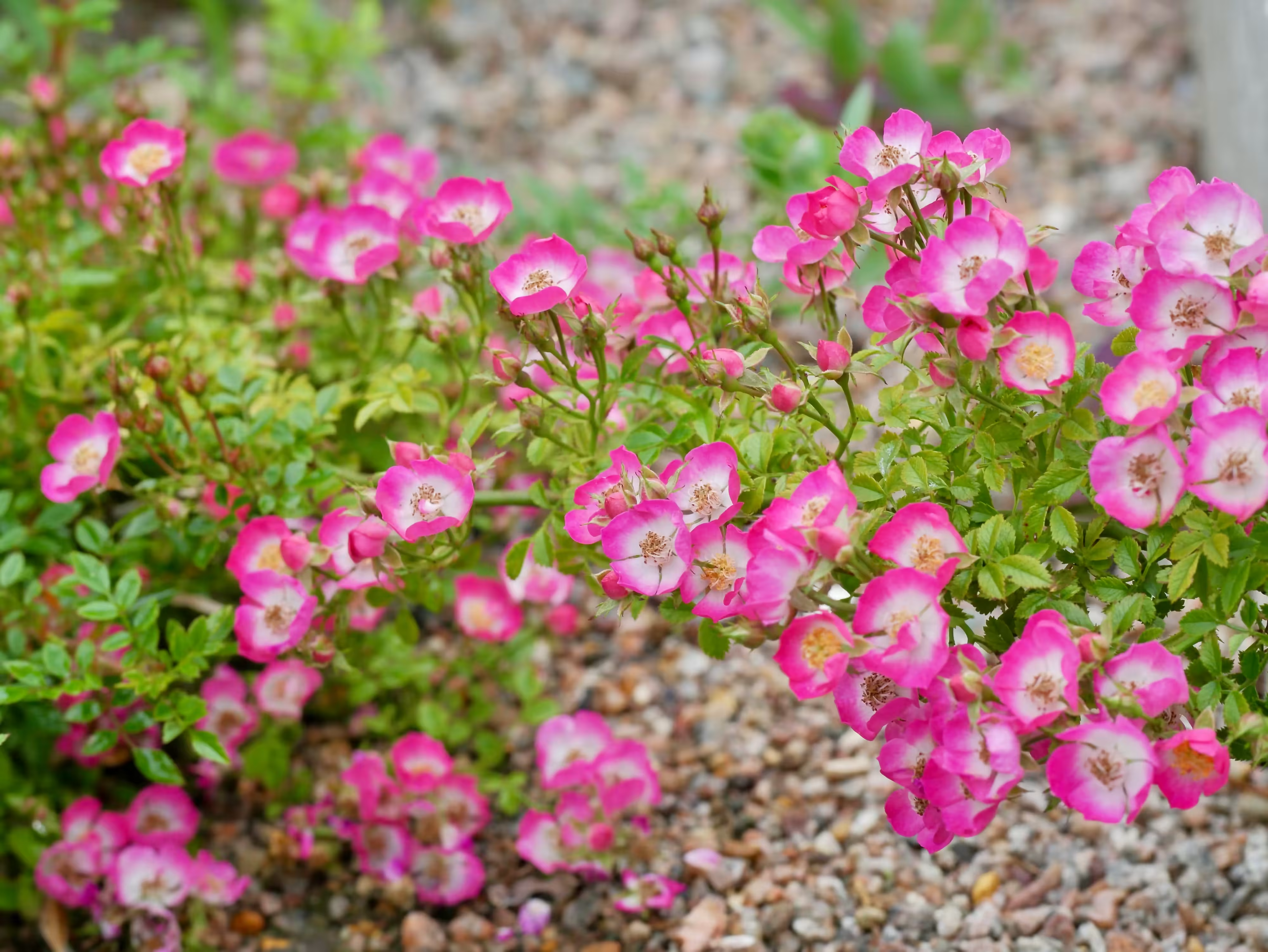
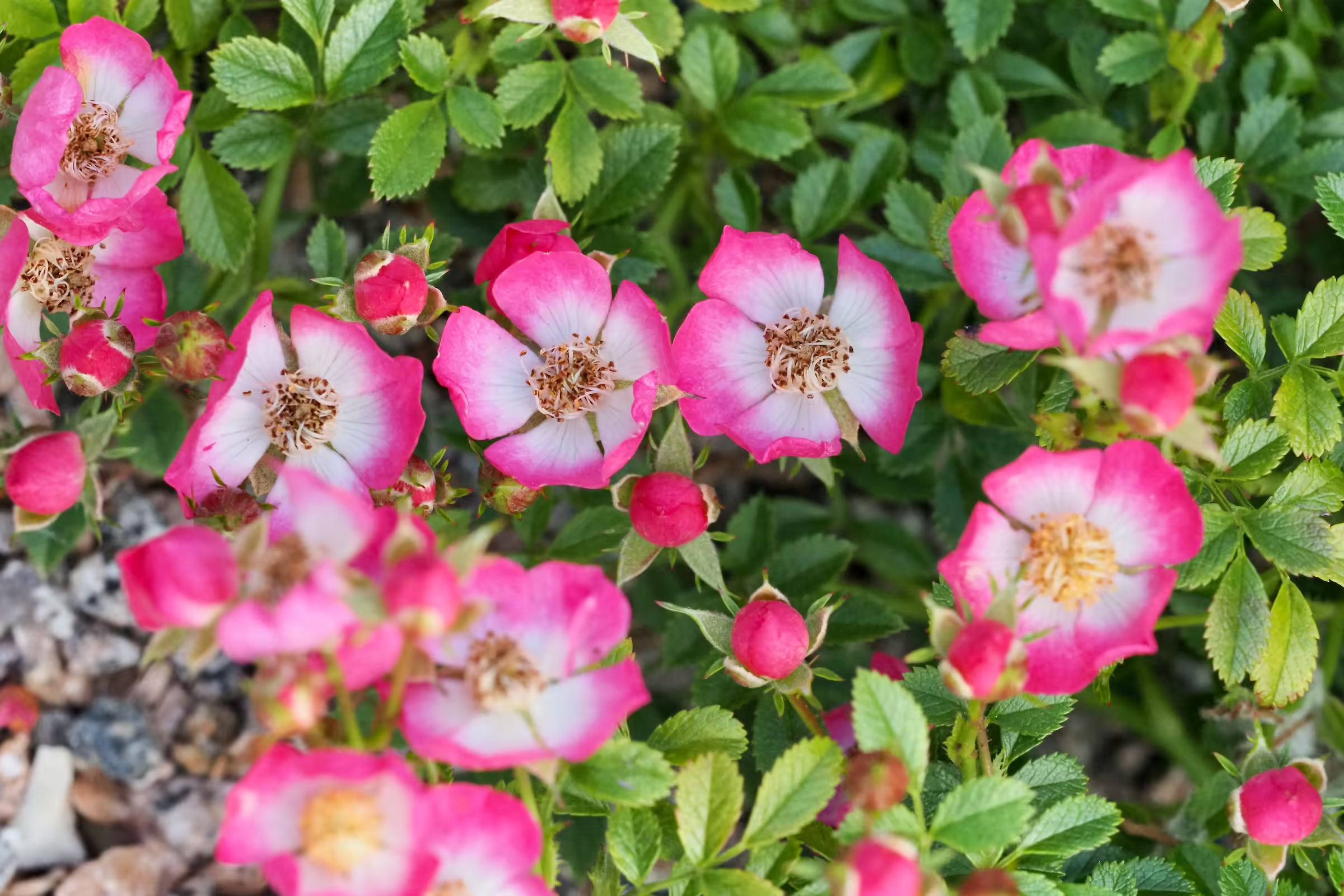
Rose ‘Cutie Pie’ is a groundbreaking miniature shrub rose – 30 years in the making. It forms a mounding ground-cover of downward arching stems clothed in fine, dense foliage. In summer it carries clusters of tiny wild-rose-like flowers just 2.5cm (1 in) across. It has many remarkable traits:
Miniature mounding habit
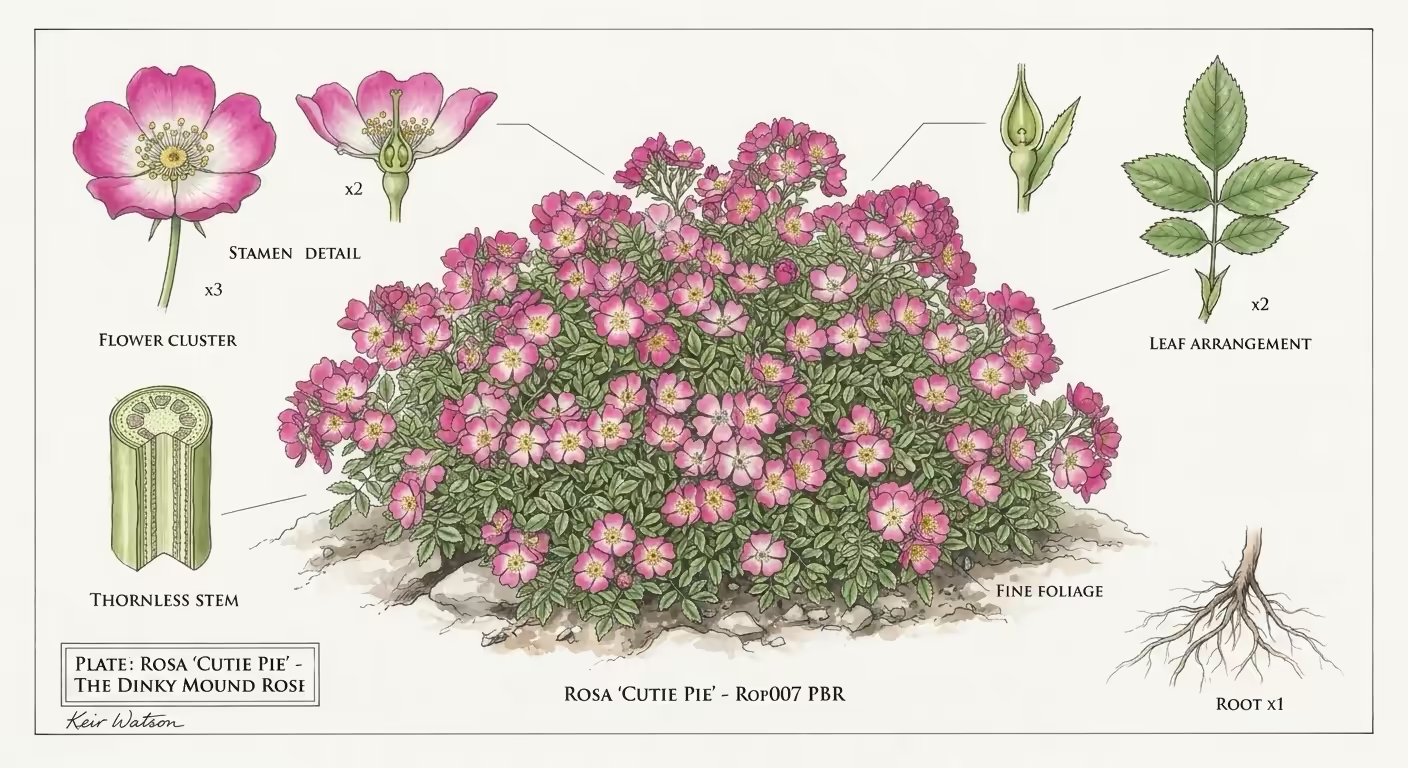
Unlike traditional leggy rose bushes, ‘Cutie Pie’ grows into extremely compact, low-growing cushions. It reaches a maximum height of just 25cm (10 inches) and spreads up to 60cm (24 inches)
Apple-blossom effect
In June, the plant is blanketed in a heavy mass of soft pink and white flowers. The visual effect mimics drifts of delicate apple blossoms rather than a heavy, stiff rose display. It is purported to flower until September, but my young plant only flowers sporadically after the main June flush.
Thornless and hip-less
The branches are entirely thornless. This makes it easy to handle and good to grow at the edge of paths or beds where it will not snag on clothes. The flowers are completely sterile and do not form hips. While it is technically self-cleaning and doesn’t produce hips, real-world experience shows that giving the mound a light haircut with scissors after the June flush is highly recommended to stimulate those later, sporadic summer blooms.
Adaptability in the garden
Despite its diminutive size ‘Cutie Pie’ is a robust and disease-free rose. Once established it is easy to look after. It needs full sun, and a soil that does not dry out. I got mine through the recent summer drought without issue. A deep soak every two weeks was all it needed. It requires minimal pruning. Like all roses it benefits from a good air-flow, so do not let it become crowded by adjacent plants.
Three decades in Development
Breeding Rosa ‘Cutie Pie’ was a work of love and dedication. The Japanese rose breeder, Tomoki Yokota, began his selective breeding programme in 1984. His specific objective was to isolate and stabilise an ultra-dwarf patio rose that combined continuous, prolific blooming with completely thornless stems. The variety was finalised and commercially launched decades later in 2021.
▽
My experience
March 2024
I purchased my ‘Cutie Pie’ as three bare root plants from Farmer Gracy in early 2024. Unfortunately, the roots were very small: little more than three short boot laces.
I planted them promptly in one of my raised beds, and kept them watered for the first year. One never sprouted. One grew weakly for a few months then gave up. Fortunately, the third one hung on and after a slow start, eventually grew away nicely.
June 2026
As you can see in the photos, by June 2026 it was developing nicely, with two main shoots covered in foliage and flowers. It has plenty of strong new shoots emerging, so I think it will go on to produce a good dense mound in a few years.
I wouldn’t recommend buying bare-root now that pot grown plants are widely available. Buying 9cm to 1L plants should ensure a much higher survival rate.
Fairy Flowers
ideas for using ‘cutie pie’
- Terracotta pot — could work in even relatively small (10inch) pots, but beware of maintenance issues: must not be allowed to dry out
- Low Hedge / edging — a practical planting along a path – particularly as it is thornless.
- Ground cover — planted en-mass Cutie Pie might make a good ground-cover between taller plants (e.g. standard roses)
- Window boxes and hanging baskets — small enough to succeed in these confined containers, but high maintenance (must not dry out)
Suggested Planting
△ Gravel Garden
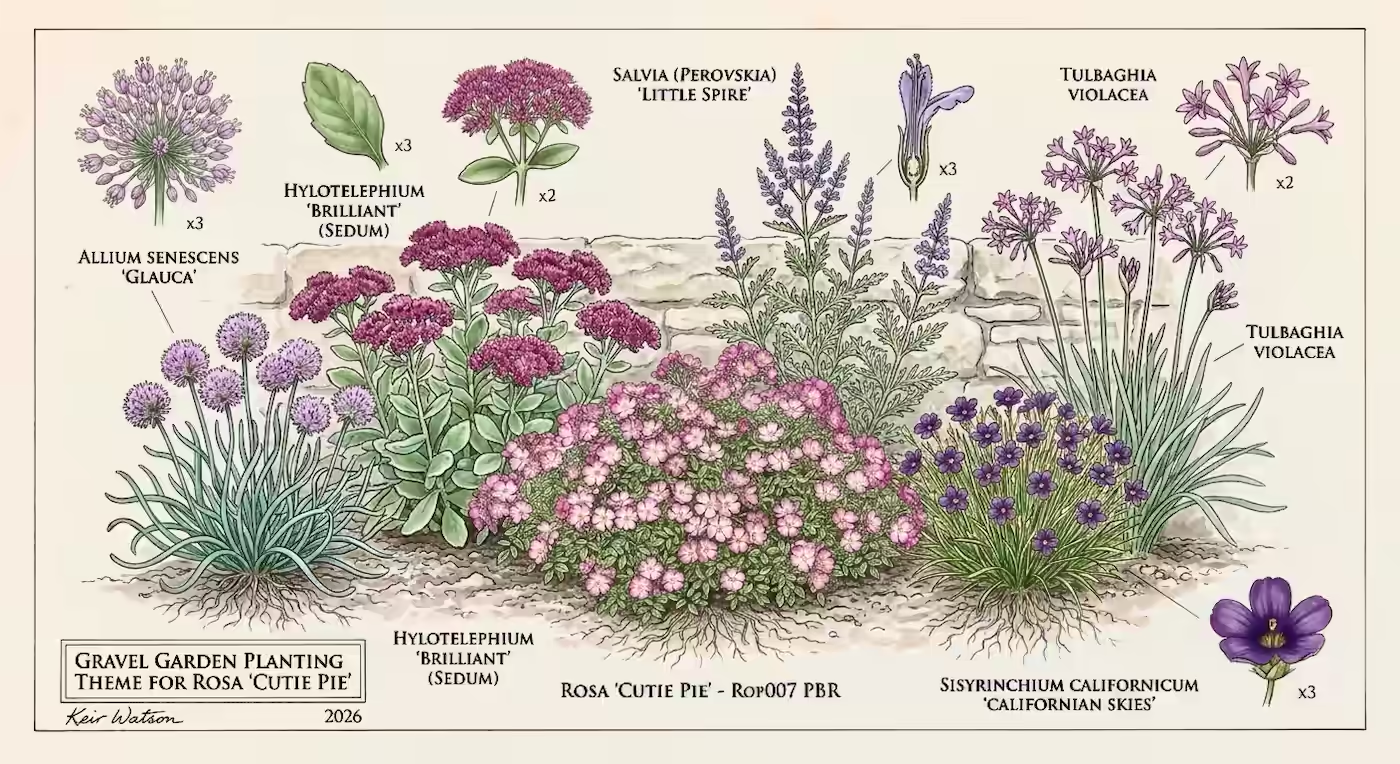
Above is a planting scheme for a hot, well drained soil in full sun. These perennials are ones that I grow in the same bed as my Cutie Pie rose. Many of them have bluish-green foliage which sets off the soft pastel colours beautifully.
Sisyrinchium ‘Californian Skies’
May–Jul H20 W20cm
Rosa ‘Cutie Pie’ (Rosa ‘Rop007’ PBR)
Jun (sporadic Jul–Sep) H25 W60cm
Tulbaghia violacea (Society Garlic)
Jul–Sep H50 W30cm
Salvia atriplicifolia ‘Little Spire’ (Russian Sage)
Jul–Oct H70 W50cm
Allium senescens subsp. glaucum
Aug–Sep H20 W25cm
Hylotelephium spectabile ‘Brilliant’ (Sedum)
Aug–Oct H40 W40cm
▽ Cottage Border
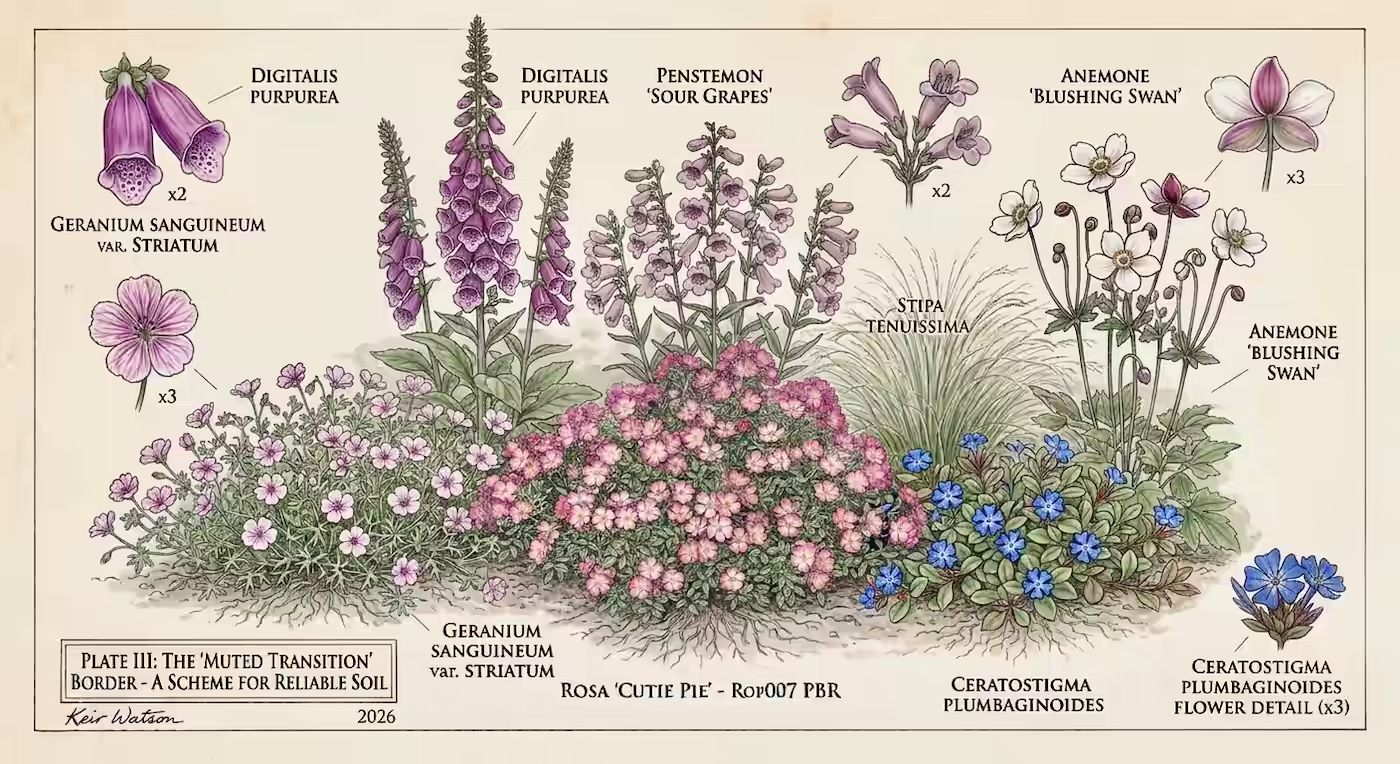
Below is a planting scheme for a sunny retentive border. These are all hardy perennials that will thrive with little attention.
Digitalis purpurea (Common Foxglove)
May–Jul H150 W45cm
Geranium sanguineum var. striatum (Bloody Cranesbill)
May–Aug H20 W30cm
Stipa tenuissima (Mexican Feather Grass)
Jun–Sep H60 W30cm
Penstemon ‘Sour Grapes’
Jul–Oct H60 W45cm
Rosa ‘Cutie Pie’ (Rosa ‘Rop007’ PBR)
Jun (sporadic Jul–Sep) H25 W60cm
Anemone ‘Blushing Swan’
Aug–Oct H60 W40cm
Ceratostigma plumbaginoides (Hardy Plumbago)
Aug–Oct H30 W45cm
Tips for Growing
Rose ‘Cutie Pie’
Although it is generally an easy plant to grow, Rosa ‘Cutie Pie’ needs some cultural care to get the most out of it.
Planting
Roses need a good deep soil. ensure the planting hole is wide and deep. Digging manure or compost into the bottom of the planting hole can help establishment. When planted, ‘Cutie Pie’ will initially send down a tap root to find water and anchor it in place. Once it has done this, it will form a mass of fibrous roots nearer the surface.
Mycorrhizal fungi
Adding mycorrhiza – such as Rootgrow -– directly to the roots when planting can greatly help roses establish and avoid replant disease.
Soil Selection
If potting into a container, choose a rich, humus-dense but sharply draining compost mix.
Location
Although Cutie Pie needs full sun, it may benefit from afternoon shade in the summer to encourage repeat flowering.
Flowering
Although technically repeat flowering, Cutie Pie puts its main effort into the initial June flush. To encourage further blooms, trim off June flowers, and give a high potash feed. It also appears that hot summer can shut down repeat flower production.
Feeding
| Feeding Stage | Recommended Product Type | Purpose / Action |
|---|---|---|
| Late Winter / Early Spring(New growth emerges) | Balanced granular rose fertiliser + organic mulch | Establishes strong foliage structure. Keep the mulch layer clear of the central wood stems to prevent rot. |
| Mid-Summer (Immediately after the main June flush) | High-potash liquid feed or dedicated rose biofertiliser | Triggers root energy recovery and coaxes the plant out of summer dormancy to establish secondary blooms. |
CHECK BACK: I will update this post in future years to let you know how my Cutie Pie rose is doing.
Thanks, good ideas!
You’re welcome!